본문
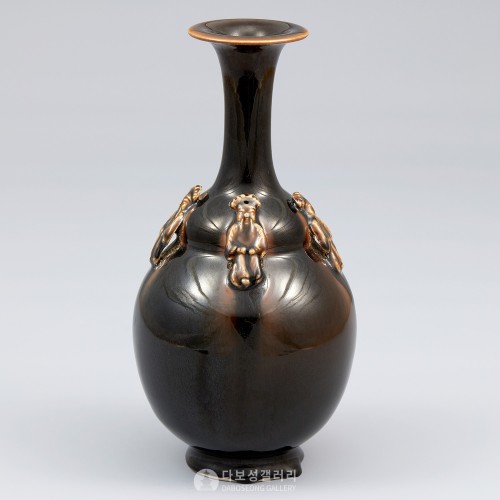
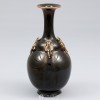
구연이 밖으로 벌어지고 목이 길며, 어깨는 한 단 부풀고 동체는 둥근 형태의 병입니다. 어깨에는 인물상 네 개를 첩소(貼塑) 기법으로 붙였습니다. 관을 쓰고 수염을 기른 모습으로 보아 고사(高士)나 신선(神仙)을 표현한 것으로 추정됩니다.
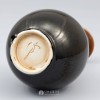
유약은 두껍게 시유되어 짙은 흑색과 강한 광택을 띱니다. 이처럼 검고 윤기가 도는 유약을 오금유(烏金釉)라고 하며, 오(烏)는 까마귀를 뜻합니다. 구연과 인물상처럼 도드라진 부분은 유약이 얇아 적갈색을 띠며, 굽바닥에는 흰 태토가 드러납니다.
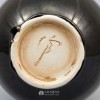
굽바닥에는 '官(관)' 명문을 새겼습니다. 정요는 하북성 곡양(曲陽) 일대의 가마로, 북송대에는 황실과 관청에 도자를 공급하기도 하였습니다. 이 병 역시 명문으로 보아 황실이나 관청을 위해 제작된 것으로 추정됩니다.
정요는 백자로 유명하지만, 북송에서 금대에 걸쳐 흑유 자기도 소량 제작하였습니다. 명대 문헌 『격고요론(格古要論)』은 흑정(黑定)에 대해 색이 옻칠처럼 검고 태토는 희며, 백정보다 값이 높다고 기록하였습니다. 정요 흑유 자기는 전하는 예가 드물며, 인물상을 첩소 기법으로 붙인 사례는 더욱 희소합니다.
This vase has an everted mouth, a long neck, a raised shoulder, and a rounded body. Four human figures are applied to the shoulder using the applied modeling technique. Their official-style hats and bearded faces suggest that they represent learned recluses or immortals.
The thick glaze has a deep black color and a lustrous surface. This type of glossy black glaze is known as wujin glaze, with wu meaning “crow.” The raised areas, such as the mouth rim and the applied figures, appear reddish brown where the glaze is thinner, while the white ceramic body is exposed on the base.
The inscription “官” is incised on the base. Ding ware was produced in kilns in the vicinity of Quyang, Hebei Province, and during the Northern Song dynasty, these kilns also supplied ceramics to the imperial court and government offices. The inscription suggests that this vase may likewise have been made for the imperial court or a government office.
Ding ware is best known for its white porcelain, but black-glazed wares were also produced in small quantities from the Northern Song through the Jin dynasty. The Ming-dynasty text Gegu Yaolun records that black Ding ware had a lacquer-like black color and a white body, and was valued more highly than white Ding ware. Surviving examples of black-glazed Ding ware are rare, and those decorated with applied human figures are particularly scarce.