작품 정보
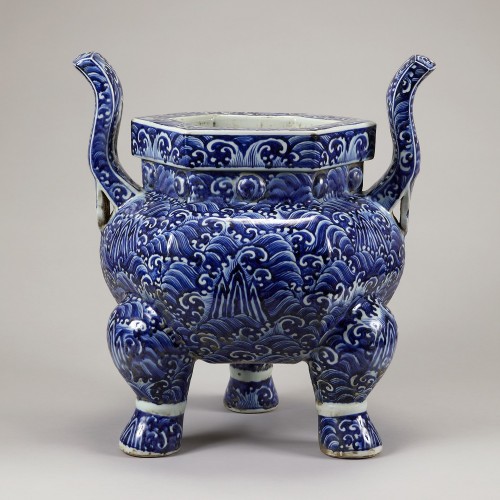
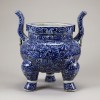
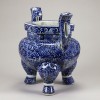
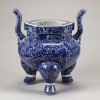
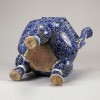
명 선덕 연간(1426~1435)에 제작된 청화백자 삼족 향로입니다. 고대 청동기의 정(鼎)을 본떠 만든 의례용 도자기입니다. 구연은 넓고 목은 짧으며, 배가 볼록하게 팽만합니다. 코끼리 다리 형태의 굵은 다리 세 개가 몸체를 받치고 있습니다. 구연부터 전체적으로 육각을 이루는 안정적인 구조입니다. 어깨에는 위를 향한 손잡이 두 개가 부착되어 있습니다.
동체 가득 청화로 수산복해문(壽山福海紋)이 선명하게 시문되었습니다. 수산복해는 '산과 같은 수명과 바다 같은 복'을 의미하는 말로, 파도치는 바다와 그 사이로 솟은 절벽으로 표현됩니다. 일반적으로 무한한 복과 장수를 기원하는 의미로 해석되지만, 의례용 도자기에 사용된 수산복해문은 평화롭고 통일된 제국에 대한 염원을 함께 표현하기도 합니다.
고대에는 주로 청동기를 의례에 사용하였으나, 송대 이후에는 고급 도자기를 사용하였습니다. 원대에는 경덕진에 부량자국(浮梁瓷局)을 설치하여 의례용 도자기를 제작하였습니다. 명나라 홍무 연초에는 어요창(御窯廠)이 설치된 뒤, 의례에는 도자기를 사용하도록 하여 청동기를 모방한 의례용 도자기가 황실의 명으로 제작되었습니다. 이 유물도 황실의 의례를 위해 만든 향로로 추정됩니다. 중국 북경고궁박물관에도 유사한 유물이 소장되어 있습니다.
━━━━━
此为明宣德年间(1426—1435年)制作的青花白瓷三足香炉。器形仿自古代青铜礼器中的鼎,为礼制用器。香炉宽口,短颈,鼓腹,下承三只粗壮的象足。自口沿至器身整体呈六棱形结构,造型端庄稳重。肩部对称附有两只朝天耳。
器身通体以青花绘寿山福海纹,纹饰清晰醒目。“寿山福海”寓意“寿如山高,福如海深”,画面以波涛翻涌的大海与海中耸立的山崖加以表现。此纹样通常象征无尽福寿,而用于礼制器物之上时,亦寄寓对国家安定、天下一统的美好祈愿。
古代礼制原以青铜礼器为主,宋代以后逐渐以高级瓷器代替。元代在景德镇设立浮梁瓷局,专门烧造礼制用瓷。明洪武初年设立御窑厂后,明确以瓷器取代青铜礼器用于礼制,由皇室下令烧造仿青铜形制的礼制瓷器。本器应为皇室礼制所用香炉,中国北京故宫博物院亦藏有相似器例。
━━━━━
This is a blue and white porcelain tripod censer produced during the Xuande period (1426–1435) of the Ming Dynasty. It is a ceremonial porcelain vessel modeled after the ancient bronze ding (鼎). The mouth is wide, the neck is short, and the belly is bulging. Three thick legs in the shape of elephant legs support the body. It features a stable structure that forms a hexagonal shape overall from the mouth. Two handles facing upwards are attached to the shoulder.
The body is vividly decorated with the Shoushan Fuhai (Longevity Mountain and Fortune Sea) design in underglaze blue. Shoushan Fuhai means "longevity like a mountain and fortune like the sea," depicted by crashing waves and cliffs rising from them. While generally interpreted as wishing for infinite fortune and longevity, the Shoushan Fuhai design used on ceremonial porcelain also expresses a desire for a peaceful and unified empire.
In ancient times, bronze vessels were mainly used for ceremonies, but high-quality porcelain came into use after the Song Dynasty. During the Yuan Dynasty, the Fuliang Porcelain Bureau (浮梁瓷局) was established in Jingdezhen to produce ceremonial porcelain. In the early Hongwu period of the Ming Dynasty, after the Imperial Kiln (御窯廠) was established, porcelain was mandated for ceremonies, and ceremonial porcelain imitating bronze ware was produced by imperial order. This artifact is also presumed to be a censer made for imperial ceremonies. A similar artifact is in the collection of the Beijing Palace Museum in China.
CONDITION
NOTICE
상담/문의 : 02- 730-5601 / 02- 730-7566